Clear Isn't Clean: The Twenty-Minute Water Audit Under Your UK Bench
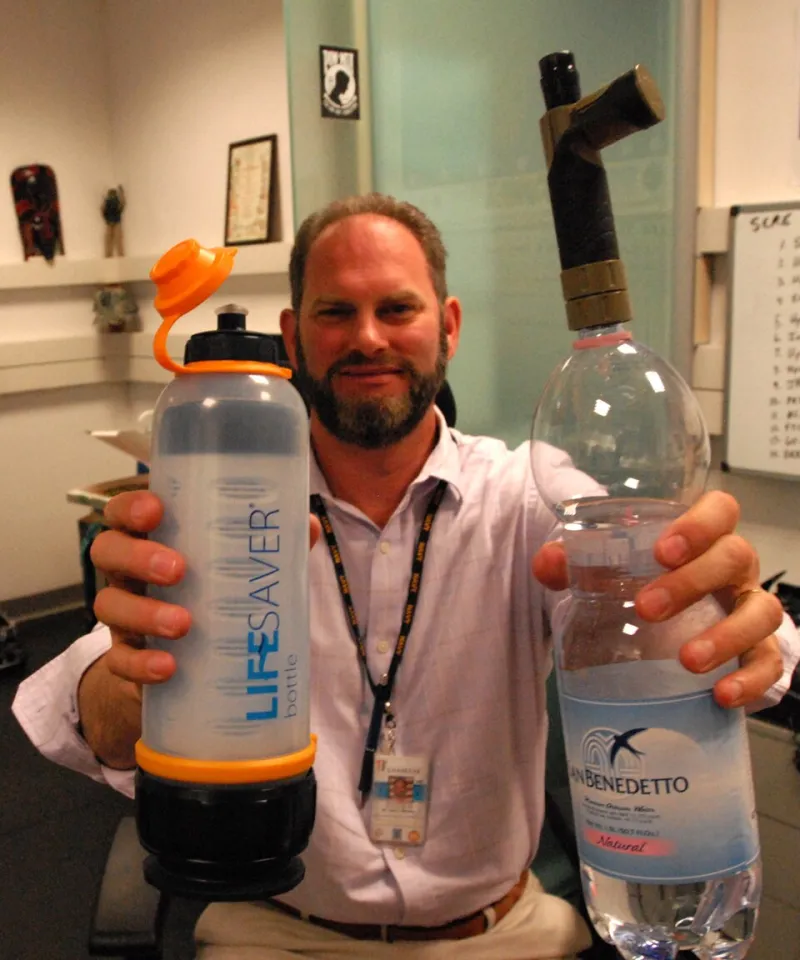
Photo: US Army Africa from Vicenza, Italy, Public domain, via Wikimedia Commons
Water is the reagent every UK bench uses and almost nobody audits. It arrives through a tap, a pretreatment pack, a reverse-osmosis membrane and a polishing cartridge, then sits in a loop that might be stagnant, warm or quietly growing a biofilm. The display says 18.2 MΩ·cm, so everyone relaxes. That number is a snapshot, not a guarantee.
A twenty-minute audit won't turn you into a water chemist. It will, however, catch the usual suspects before they reach your qPCR, your cell culture or your LC-MS. Here's how to do it without dismantling the system.
Start at the feed, not the dispenser
Most bench arguments about water quality begin at the point of use. The more useful question is what's going into the system. UK feed water is not one thing: hard water across parts of the South East, softer supplies in Scotland and Wales, and older buildings with who-knows-what in the pipework. Chlorine and chloramine levels, conductivity, pressure and temperature all affect how hard the pretreatment pack is working.
Ask your lab manager where the feed-water report lives. If nobody knows, that's finding number one. A system fed on softened or RO water is not the same as one plumbed straight into mains. Neither is a system that shares a line with a glasswasher. Check the pretreatment change log against the vendor's stated capacity — litres or time, whichever comes first. A resin bed exhausted in August will not care that the sticker says November.
The display is a temperature-compensated snapshot
Resistivity is usually quoted at 25°C. A reading of 18.2 MΩ·cm is excellent; a reading of 17.8 might be fine for some work and marginal for others. The display also tells you nothing about total organic carbon, microbial counts or endotoxin. Those need separate tests, and they need to be done on a schedule that matches your assay's sensitivity.
Look at when the conductivity cell was last calibrated, and whether the meter is compensating correctly. Then look at the loop. Is the water recirculating overnight, or sitting still in a dead leg? Stagnation is the friend of biofilm. A short flush before use is not a ritual; it's a control measure. If your system has a point-of-use filter, note its age and whether anyone has checked the differential pressure or flow.
The log is the audit trail, not the decoration
Filter and polishing-pack changes are where documentation quietly falls apart. The sticker on the cartridge says one date; the logbook says another; the service engineer's email says a third. Pick the one that reflects what actually happened and reconcile it.
For each consumable, record the install date, the litres processed where available, the UV lamp hours, and the signature of the person who changed it. If the system has an ultrafilter for endotoxin and nuclease control, it needs its own line. So does any 0.2 µm vent filter. A missing signature is not a clerical issue: it means you cannot demonstrate that the water feeding a run was within specification.
Biofilm doesn't book itself in
Biofilm is the quiet problem. It forms on wetted surfaces, especially silicone tubing, valve seats and the inside of dispenser heads. It can shed intermittently, which is why one good reading proves very little. In clinical or healthcare-adjacent labs, the relevant water-safety thinking overlaps with HTM 04-01, but even in a standard research lab the principle holds: keep the system wet, flowing and monitored.
Ask three questions. When was the tubing last replaced? Is the dispenser head cleaned on a defined schedule? Does anyone swab or sample the point of use, not just the recirculating loop? If the answer to all three is a shrug, you've found a risk worth escalating.
Endotoxin and nucleases are assay-specific
Water that is chemically pure can still ruin a cell-culture experiment or a sensitive molecular assay. Endotoxin testing — whether by LAL or recombinant factor C — belongs on the schedule if your work touches mammalian cells, transfection or anything destined for a regulated environment. DNase and RNase contamination matters for PCR, RNA work and some sequencing preps. These tests are not interchangeable, and a generic 'ultrapure' label does not cover them.
Match the test to the assay. A lab running HPLC mobile phase has different priorities from one doing primary cell isolation. Write down which grade of water each protocol actually needs, then check whether the system and the testing regime deliver it.
A twenty-minute bench audit
- Find the feed-water report and the pretreatment change log.
- Photograph the current resistivity and TOC readings; note the date and time.
- Check the calibration date on the conductivity meter.
- Reconcile cartridge, UV lamp and filter dates against the logbook.
- Confirm the loop recirculates overnight and identify any dead legs.
- Ask when the dispenser head and tubing were last cleaned or replaced.
- Check whether endotoxin or nuclease testing is on the schedule — and whether it matches your assay.
- Look at the service contract: who is responsible for what, and when is the next visit?
None of this requires a specialist. It requires somebody to look, write it down and raise a flag if the story doesn't hang together.
When the audit fails
Don't just swap the cartridge and carry on. A failed reading or a missed change is a signal to do a root-cause check: feed quality, stagnation, exhausted resin, a UV lamp past its hours, or a dispensing head that needs attention. Document the finding, tell the lab manager, and assess which runs may have been affected. If your lab works under UKAS accreditation or a quality management system, the impact assessment is part of the record, not an afterthought.
Clear water is easy to trust. Fit-for-purpose water is something you can evidence. The difference is usually a logbook, a calendar reminder and twenty minutes at the bench.